
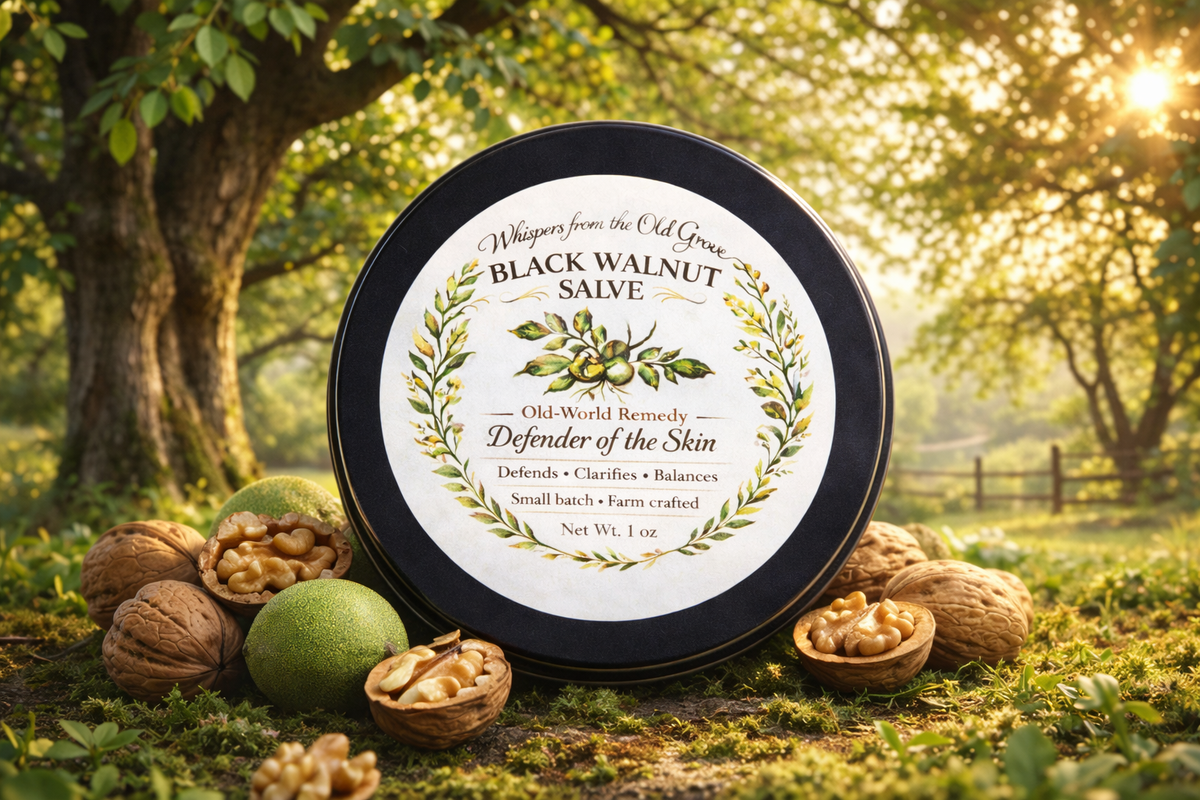
Black Walnut - Salve
Black Walnut - Salve
Couldn't load pickup availability
A powerful botanical defense salve that purifies, protects, and restores with deep herbal potency.
WHY THIS FORMULA EXCELS
- Targeted antimicrobial system: Black walnut + manuka provide complementary antifungal and antibacterial activity
- Barrier protection + delivery: Olive oil enhances penetration while beeswax seals and protects
- Skin defense + recovery: Bioactive plant compounds support healing and microbial balance
- Simple, high-potency system: Minimal ingredients with strong functional synergy
INGREDIENTS - KEY COMPONENTS - BENEFITS - SCIENTIFIC RATIONAL - REFERENCES
1. Olea Europaea (Olive) Fruit Oil infused with Juglans Nigra (Black Walnut) Hull Extract
Common Name: Olive Oil (Black Walnut Infused)
Key Components:
- Oleic acid
- Squalene
- Polyphenols (olive-derived)
- Juglone (5-hydroxy-1,4-naphthoquinone)
- Tannins and flavonoids
Clinical Benefits:
- Deep emollient hydration and barrier support
- Antimicrobial and antifungal activity
- Helps soothe irritated or compromised skin
- Supports skin cleansing and protective functions
Scientific Rationale:
Olive oil enhances lipid penetration and barrier repair, while black walnut hull compounds—particularly juglone and tannins—exhibit broad-spectrum antimicrobial and antifungal activity, supporting skin defense and microbiological balance.
2. Cera Alba (Beeswax)
Common Name: Beeswax
Key Components:
- Esters (~70%)
- Free fatty acids
- Long-chain alcohols
Clinical Benefits:
- Forms a breathable protective barrier
- Reduces transepidermal water loss (TEWL)
- Supports skin repair and protection
- Provides mild antimicrobial support
Scientific Rationale:
Creates a semi-occlusive layer that locks in hydration while allowing skin flexibility and environmental protection.
3. Leptospermum Scoparium (Manuka) Oil
Common Name: Manuka Oil
Key Components:
- β-triketones (leptospermone, isoleptospermone)
- Sesquiterpenes
- Flavonoids
Clinical Benefits:
- Potent antimicrobial and antifungal activity
- Helps calm inflamed or irritated skin
- Supports wound healing and skin recovery
- Assists in managing problematic or compromised skin conditions
Scientific Rationale:
Manuka oil contains β-triketones with strong antimicrobial activity, often effective against resistant microbial strains, while also exhibiting anti-inflammatory effects that support skin healing.
REFERENCES
- Lin, T. K., Zhong, L., & Santiago, J. L. (2018). Plant oils and skin barrier repair. International Journal of Molecular Sciences, 19(1), 70.
- Pereira, J. A., et al. (2007). Phenolic compounds and antimicrobial activity of walnut (Juglans regia/Juglans nigra) extracts. Food Chemistry, 103(3), 977–984.
- Ahmad, T., et al. (2018). Juglone and its biological activities: a review. Journal of Ethnopharmacology, 210, 1–9.
- Fratini, F., et al. (2016). Beeswax: antimicrobial activity and applications. Asian Pacific Journal of Tropical Medicine, 9(9), 839–843.
- Lis-Balchin, M., & Deans, S. G. (1997). Bioactivity of selected essential oils against bacteria and fungi. Journal of Applied Microbiology, 82(6), 759–762.
- Porter, N. G., et al. (1999). Antimicrobial activity of manuka oil and its components. Phytochemistry, 50(3), 407–415.
- Carson, C. F., et al. (2006). Antimicrobial properties of essential oils. Clinical Microbiology Reviews, 19(1), 50–62.
This information describes traditional use and published research and is not intended to diagnose, treat, cure, or prevent disease.
Talk about your brand
Share information about your brand with your customers. Describe a product, make announcements, or welcome customers to your store.