
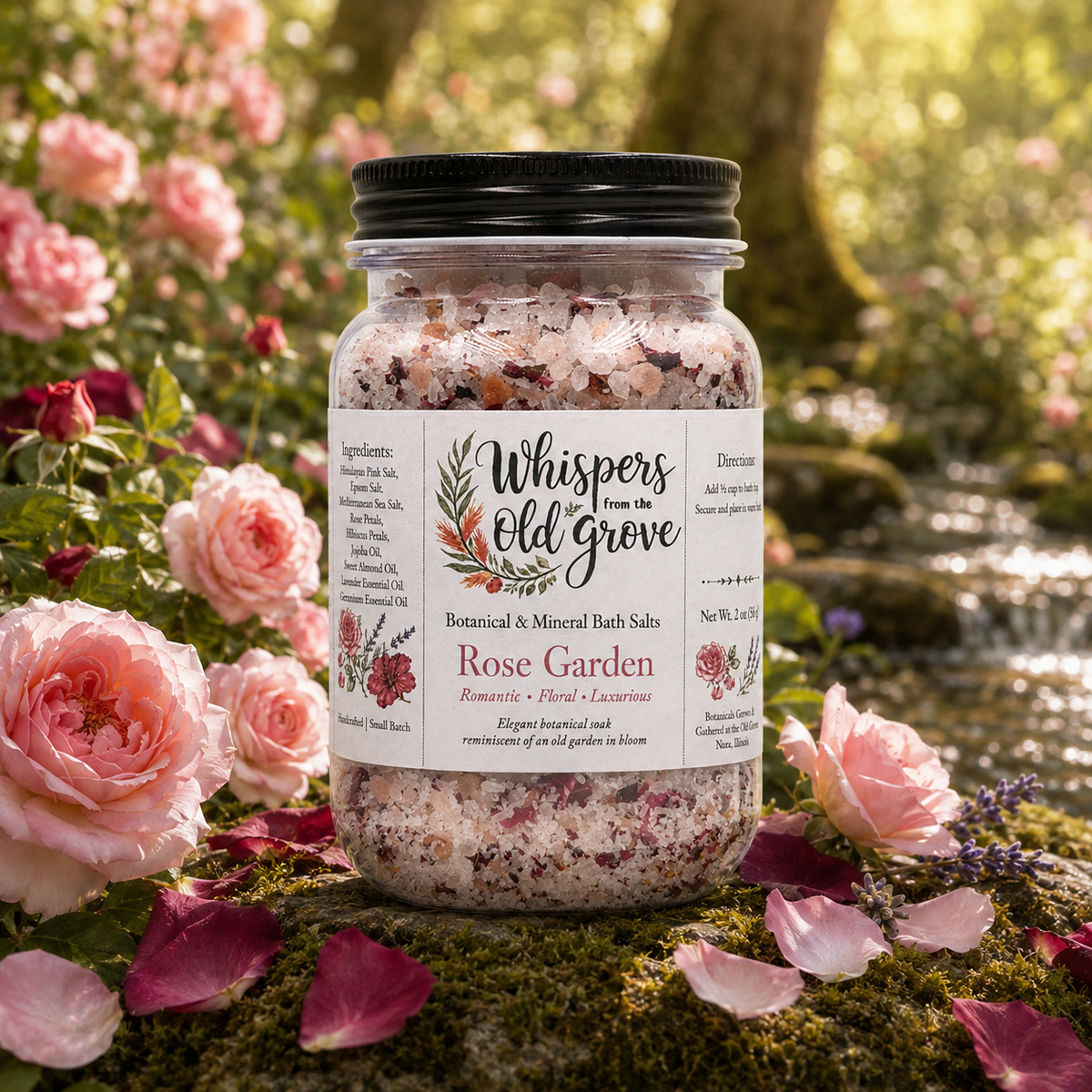
Botanical & Mineral Bath Salt - Rose Garden
Botanical & Mineral Bath Salt - Rose Garden
Couldn't load pickup availability
Inspired by flowers gathered at the height of bloom, this botanical soak combines mineral salts with richly colored petals and aromatic plant oils to create a beautiful bathing ritual that leaves skin feeling soft and cared for while surrounding the senses with a gentle garden fragrance.
KEY INGREDIENTS & BENEFITS
Himalayan Pink Salt
Common Name: Himalayan Pink Salt / Himalayan Rock Salt
Scientific/Chemical Name: Primarily Sodium Chloride (NaCl)
Himalayan pink salt is a naturally occurring rock salt composed primarily of sodium chloride with small amounts of naturally occurring minerals that contribute to its characteristic shades of pink.
Naturally Contains
- Sodium chloride
- Trace magnesium
- Calcium
- Potassium
- Iron and other trace minerals
Traditionally Used For
- Mineral-rich soaking
- Cleansing and refreshing the skin
- Relaxing bathing rituals
- Creating a restorative, spa-like experience
What Research Tells Us
However, mineral-salt bathing has been scientifically investigated. Research involving certain magnesium-rich mineral salts has demonstrated improvements in skin hydration, barrier function, and skin smoothness.
Epsom Salt
Common Name: Epsom Salt
Scientific/Chemical Name: Magnesium Sulfate Heptahydrate
MgSO₄·7H₂O
Epsom salt has been used for generations as part of warm, relaxing mineral baths.
Naturally Contains
- Magnesium
- Sulfate
Traditionally Used For
- Relaxing mineral baths
- Soaking after long or active days
- Comforting tired bodies
- Foot and full-body baths
- End-of-day bathing rituals
What Research Tells Us
Magnesium is an essential mineral involved in numerous biological functions.
Research involving certain magnesium-rich mineral baths has demonstrated improvements in skin hydration and barrier function.
Mediterranean Sea Salt
Common Name: Mediterranean Sea Salt
Scientific/Chemical Name: Primarily Sodium Chloride (NaCl)
Harvested from seawater, Mediterranean sea salt brings the timeless tradition of mineral-rich sea bathing into this floral botanical soak.
Naturally Contains
- Sodium chloride
- Naturally occurring trace marine minerals
- Small amounts of magnesium, calcium, and potassium depending upon the source
Traditionally Used For
- Mineral bathing
- Cleansing and refreshing the skin
- Softening the feel of rough skin
- Restorative sea-inspired bathing rituals
What Research Tells Us
Research involving certain mineral-rich marine salts—particularly magnesium-rich Dead Sea salts—has demonstrated improvements in skin hydration, smoothness, and barrier function.
BOTANICALS FROM THE GARDEN
Rose Petals
Common Name: Damask Rose
Scientific Name: Rosa damascena Mill.
For centuries, rose has held a treasured place in botanical bathing, perfumery, and traditional beauty rituals.
Its petals bring delicate fragrance, beautiful color, and naturally occurring plant compounds to the bath.
Naturally Contains
- Flavonoids
- Phenolic compounds
- Anthocyanins
- Naturally occurring antioxidants
- Trace aromatic constituents
Traditionally Used For
- Luxurious floral bathing
- Beautifying skin rituals
- Comforting and refreshing the skin
- Relaxation
- Creating a gentle floral atmosphere
What Research Tells Us
Rose has been extensively studied for its phytochemical composition.
Research involving Rosa damascena preparations has identified antioxidant, anti-inflammatory, antimicrobial, and aromatic properties.
Human research has also explored rose aroma and preparations in relation to relaxation and emotional well-being.
Hibiscus Petals
Common Name: Hibiscus / Roselle
Scientific Name: Hibiscus sabdariffa L.
Deep ruby hibiscus brings dramatic natural beauty to the blend.
Rich in colorful plant pigments and polyphenols, hibiscus has a long history of use in traditional botanical preparations throughout Africa, Asia, the Middle East, and other regions of the world.
Naturally Contains
- Anthocyanins
- Flavonoids
- Phenolic acids
- Organic acids
- Naturally occurring polyphenols
The rich red color of hibiscus comes primarily from naturally occurring anthocyanin pigments.
Traditionally Used For
- Botanical skin preparations
- Refreshing herbal washes
- Beautifying rituals
- Traditional antioxidant-rich preparations
- Floral and herbal bathing
What Research Tells Us
Hibiscus has attracted considerable scientific interest because of its rich concentration of anthocyanins, phenolic compounds, and organic acids.
Laboratory research has demonstrated antioxidant activity associated with Hibiscus sabdariffa extracts and has investigated anti-inflammatory, antimicrobial, and skin-related properties of its phytochemicals.
Much of the clinical hibiscus research involves drinking hibiscus preparations rather than topical application. These findings should therefore not be interpreted as evidence that hibiscus bathwater produces systemic health effects.
In a bath soak, hibiscus is best appreciated for its antioxidant-rich botanical character, traditional use, and beautiful natural color.
SKIN-CONDITIONING BOTANICAL OIL
Jojoba Oil
Common Name: Jojoba Oil
Scientific Name: Simmondsia chinensis (Link) C.K.Schneid. Seed Oil
Although commonly called an oil, jojoba is technically a liquid botanical wax composed primarily of long-chain wax esters.
Its exceptional stability and affinity for the skin make it a treasured ingredient in botanical skin care.
Naturally Contains
- Long-chain wax esters
- Fatty acids
- Fatty alcohols
- Tocopherols
- Phytosterols
Traditionally & Cosmetically Used For
- Softening dry-feeling skin
- Conditioning the skin
- Supporting a smooth and supple after-bath feel
- Botanical skin care
- Carrying aromatic botanical oils
What Research Tells Us
Dermatologic research recognizes jojoba for its emollient and skin-conditioning properties.
Scientific literature has also explored its anti-inflammatory and skin-supportive potential.
In this mineral bath, jojoba provides an important conditioning element, helping leave the skin feeling soft, smooth, and cared for after soaking.
AROMATIC BOTANICAL OILS
Geranium Essential Oil
Common Name: Geranium / Rose Geranium Essential Oil
Scientific Name: Pelargonium graveolens L'Hér. Essential Oil
Geranium brings a sophisticated green-floral aroma reminiscent of rose, but with a fresh botanical character all its own.
It beautifully bridges the rich floral character of rose and hibiscus with the softer aroma of lavender.
Naturally Contains
- Citronellol
- Geraniol
- Linalool
- Citronellyl formate
- Isomenthone and related aromatic compounds
Traditionally Used For
- Botanical skin preparations
- Aromatic bathing
- Relaxation
- Perfumery
- Creating a balanced and uplifting floral atmosphere
What Research Tells Us
Geranium essential oil has been investigated experimentally for antioxidant, antimicrobial, and anti-inflammatory activity.
Emerging human research has also explored inhaled Pelargonium graveolens essential oil in relation to anxiety, stress, and emotional well-being.
In this bath soak, geranium is best appreciated for its elegant floral aroma and its ability to create an uplifting yet balanced sensory experience.
Lavender Essential Oil
Common Name: Lavender Essential Oil
Scientific Name: Lavandula angustifolia Mill. Essential Oil
Lavender softens the rich floral character of rose and geranium with its familiar, peaceful floral-herbal aroma.
Naturally Contains
- Linalool
- Linalyl acetate
- Terpinen-4-ol
- β-Caryophyllene
- Other naturally occurring aromatic compounds
Traditionally Used For
- Relaxation
- Peaceful evening baths
- Creating a calming atmosphere
- Aromatic botanical rituals
- Encouraging a sense of restfulness
What Research Tells Us
Lavender is among the most extensively researched essential oils used in aromatherapy.
Clinical trials and systematic reviews have investigated lavender in relation to anxiety, stress, relaxation, and sleep.
A systematic review and meta-analysis published in Phytomedicine found evidence supporting an anxiety-reducing effect of lavender across multiple studies, although study designs, concentrations, and methods of administration varied.
THE COMBINED BATHING EXPERIENCE
Mineral-Rich Soaking
Himalayan Pink Salt + Epsom Salt + Mediterranean Sea Salt
Three mineral salts create the foundation of the bath, bringing together traditions of mineral soaking and sea bathing.
The warm mineral water creates a beautiful foundation for the flowers, jojoba, and aromatic botanical oils.
Floral Botanical Beauty
Rose + Hibiscus + Jojoba
Rose and hibiscus create the botanical heart of this blend.
Rose brings centuries of traditional beauty rituals and a delicate floral character.
Hibiscus contributes its deep ruby color and naturally occurring anthocyanins and polyphenols.
Jojoba completes the trio by conditioning the skin and helping leave it feeling soft and supple.
Together they create a bath that feels both beautiful and nurturing.
Garden Aromatherapy
Geranium + Lavender
Geranium and lavender create an elegant floral pairing.
Geranium brings a fresh, green, rose-like character.
Lavender brings softness and calm.
Together, they surround the bath with an aroma reminiscent of stepping quietly into a flower garden just after the morning dew.
One uplifts.
One quiets.
Together, they create balance.
WHY THESE INGREDIENTS WORK SO BEAUTIFULLY TOGETHER
This bath soak is built around three complementary experiences:
MINERALS
Himalayan Pink Salt • Epsom Salt • Mediterranean Sea Salt
Create the foundation of a traditional mineral soaking ritual.
FLORAL BOTANICALS
Rose • Hibiscus • Jojoba
Combine richly colored flowers with a skin-conditioning botanical oil.
AROMATICS
Geranium • Lavender
Balance an elegant rose-like floral aroma with the peaceful softness of lavender.
Together they create a bathing experience that feels:
THE SCIENCE BEHIND THE BOTANICALS
Our ingredients are selected with respect for both traditional botanical knowledge and modern scientific research.
Scientific studies have explored the antioxidant-rich phytochemicals found in rose and hibiscus, the skin-conditioning properties of jojoba, the aromatic properties of geranium and lavender, and the effects of certain magnesium-rich mineral baths on skin hydration and barrier function.
PEER-REVIEWED REFERENCES
Proksch E, Nissen HP, Bremgartner M, Urquhart C. Bathing in a magnesium-rich Dead Sea salt solution improves skin barrier function, enhances skin hydration, and reduces inflammation in atopic dry skin. International Journal of Dermatology. 2005;44(2):151–157. doi:10.1111/j.1365-4632.2005.02079.x.
Pazyar N, Yaghoobi R, Ghassemi MR, Kazerouni A, Rafeie E, Jamshydian N. Jojoba in dermatology: a succinct review. Giornale Italiano di Dermatologia e Venereologia. 2013;148(6):687–691.
Nayebi N, Khalili N, Kamalinejad M, Emtiazy M. A systematic review of the efficacy and safety of Rosa damascena Mill. with an overview on its phytopharmacological properties. Complementary Therapies in Medicine. 2017;34:129–140.
Mahadevan N, Shivali, Kamboj P. Hibiscus sabdariffa Linn.—An overview. Natural Product Radiance. 2009;8(1):77–83.
Da-Costa-Rocha I, Bonnlaender B, Sievers H, Pischel I, Heinrich M. Hibiscus sabdariffa L.—A phytochemical and pharmacological review. Food Chemistry. 2014;165:424–443. doi:10.1016/j.foodchem.2014.05.002.
Seo E, Cho Y, Lee JM, Seol GH. Inhalation of Pelargonium graveolens essential oil alleviates pain and related anxiety and stress in patients with lumbar spinal stenosis and moderate to severe pain. Pharmaceuticals. 2024;17(1):1.
Donelli D, Antonelli M, Bellinazzi C, Gensini GF, Firenzuoli F. Effects of lavender on anxiety: A systematic review and meta-analysis. Phytomedicine. 2019;65:153099.
Koulivand PH, Khaleghi Ghadiri M, Gorji A. Lavender and the nervous system. Evidence-Based Complementary and Alternative Medicine. 2013;2013:681304.
This information describes traditional use and published research and is not intended to diagnose, treat, cure, or prevent disease.
Talk about your brand
Share information about your brand with your customers. Describe a product, make announcements, or welcome customers to your store.