
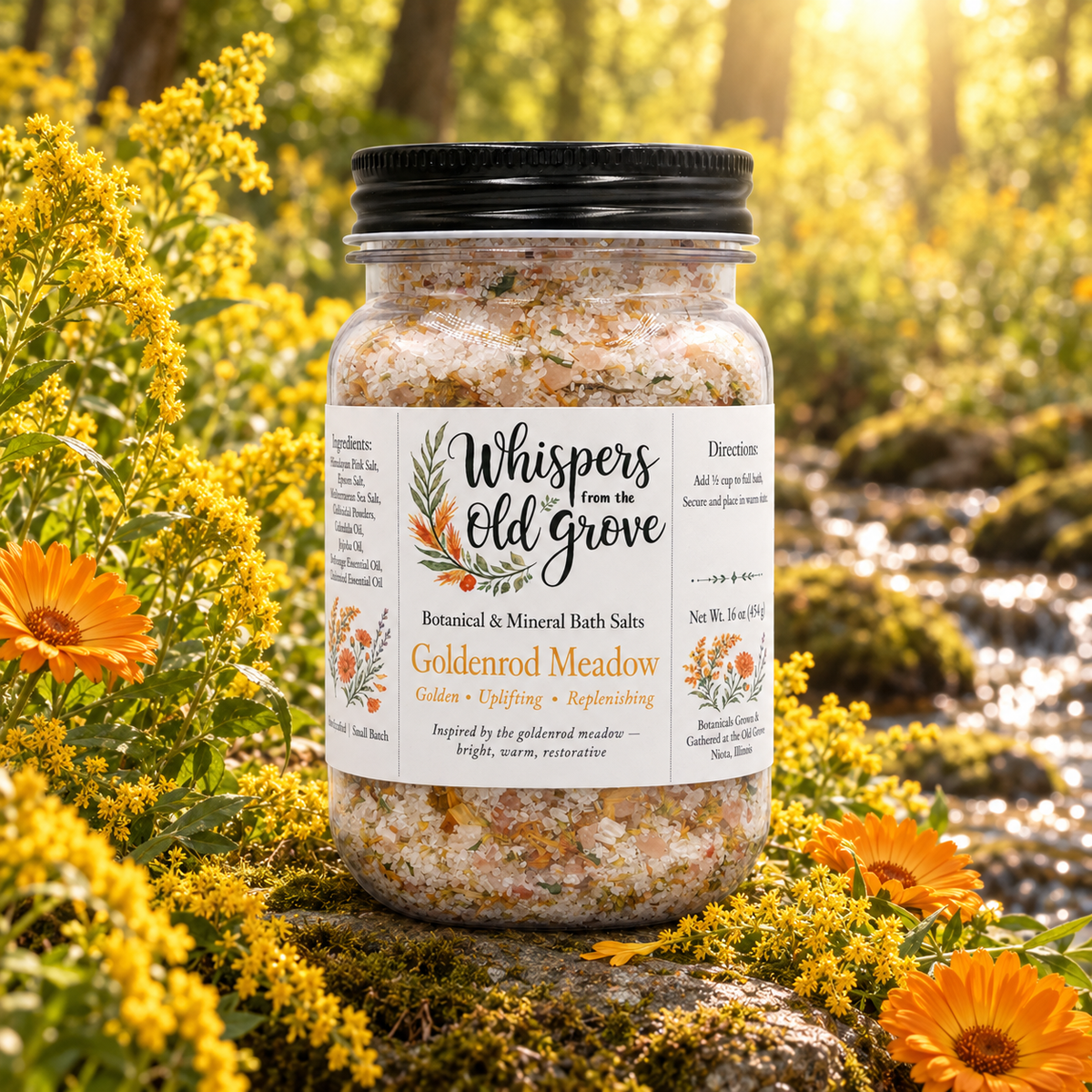
Botanical & Mineral Bath Salt - Goldenrod Meadow
Botanical & Mineral Bath Salt - Goldenrod Meadow
Couldn't load pickup availability
.
Inspired by golden meadows and late-summer gardens, this botanical soak brings together traditional herbs, mineral salts, and aromatic plant oils to create a beautifully restorative bathing ritual that leaves skin feeling soft and the senses refreshed.
KEY INGREDIENTS & BENEFITS
Himalayan Pink Salt
Common Name: Himalayan Pink Salt / Himalayan Rock Salt
Scientific/Chemical Name: Primarily Sodium Chloride (NaCl)
Himalayan pink salt is a naturally occurring rock salt composed primarily of sodium chloride with small amounts of naturally occurring minerals responsible for its characteristic shades of pink.
Naturally Contains
- Sodium chloride
- Trace magnesium
- Calcium
- Potassium
- Iron and other trace minerals
Traditionally Used For
- Mineral-rich soaking
- Cleansing and refreshing the skin
- Relaxing bathing rituals
- Creating a restorative, spa-like experience
What Research Tells Us
Research specifically demonstrating unique therapeutic benefits from Himalayan pink salt baths remains limited.
However, mineral-salt bathing has been studied scientifically. Research involving magnesium-rich mineral salts has demonstrated improvements in skin hydration, barrier function, and skin smoothness.
Epsom Salt
Common Name: Epsom Salt
Scientific/Chemical Name: Magnesium Sulfate Heptahydrate
MgSO₄·7H₂O
Epsom salt has been added to warm baths for generations and remains one of the most familiar ingredients in traditional mineral soaking rituals.
Naturally Contains
- Magnesium
- Sulfate
Traditionally Used For
- Relaxing mineral baths
- Soaking after active days
- Comforting tired bodies
- Foot and full-body baths
- Restful evening rituals
What Research Tells Us
Magnesium is an essential mineral involved in numerous biological processes.
Research involving certain magnesium-rich mineral baths has demonstrated improvements in skin hydration and barrier function.
Mediterranean Sea Salt
Common Name: Mediterranean Sea Salt
Scientific/Chemical Name: Primarily Sodium Chloride (NaCl)
Harvested from seawater, Mediterranean sea salt brings the timeless tradition of sea bathing into a modern botanical soak.
Naturally Contains
- Sodium chloride
- Naturally occurring trace marine minerals
- Small amounts of magnesium, calcium, and potassium depending upon its source
Traditionally Used For
- Mineral bathing
- Cleansing and refreshing the skin
- Softening the feel of rough skin
- Restorative sea-inspired bathing rituals
What Research Tells Us
Scientific studies involving certain mineral-rich marine salts—particularly magnesium-rich Dead Sea salts—have demonstrated improvements in skin hydration, smoothness, and barrier function.
BOTANICALS FROM THE MEADOW
Goldenrod Flowers
Common Name: Goldenrod
Scientific Name: Solidago spp.
Goldenrod's brilliant yellow flowers have a long history in North American and European herbal traditions.
Its botanical name, Solidago, comes from the Latin solidare—often interpreted as “to make whole.”
Naturally Contains
Goldenrod contains a diverse collection of plant compounds, including:
- Flavonoids
- Quercetin derivatives
- Rutin
- Phenolic compounds
- Triterpene saponins
- Naturally occurring aromatic constituents
Traditionally Used For
- Herbal skin preparations
- Washing and bathing preparations
- Comforting minor skin irritation
- Traditional wound and skin care
- Seasonal botanical remedies
What Research Tells Us
Goldenrod contains flavonoids, phenolic compounds, saponins, and other phytochemicals that have been investigated for antioxidant, anti-inflammatory, and antimicrobial activities.
Calendula Petals
Common Name: Calendula / Pot Marigold
Scientific Name: Calendula officinalis L.
Calendula's brilliant golden-orange petals have been used for centuries in traditional skin preparations, salves, washes, and botanical baths.
Naturally Contains
- Flavonoids
- Carotenoids
- Triterpenoids
- Phenolic compounds
- Naturally occurring botanical antioxidants
Traditionally Used For
- Soothing delicate skin
- Comforting dry or irritated-feeling skin
- Traditional skin preparations
- Herbal bathing
- Supporting healthy-looking skin
What Research Tells Us
Calendula is one of the better-studied traditional skin botanicals.
Research has investigated calendula preparations for their anti-inflammatory, antioxidant, and skin-supportive properties.
A systematic review examining Calendula officinalis and wound healing found promising evidence in several studies, while also concluding that clinical findings remain inconsistent and additional high-quality research is needed.
SKIN-CONDITIONING BOTANICAL OIL
Jojoba Oil
Common Name: Jojoba Oil
Scientific Name: Simmondsia chinensis (Link) C.K.Schneid. Seed Oil
Although commonly called an oil, jojoba is technically a liquid botanical wax composed primarily of long-chain wax esters.
Its unique composition and exceptional stability have made it a prized ingredient in botanical skin care.
Naturally Contains
- Long-chain wax esters
- Fatty acids
- Fatty alcohols
- Tocopherols
- Phytosterols
Traditionally & Cosmetically Used For
- Softening dry-feeling skin
- Conditioning the skin
- Supporting a smooth, supple after-bath feel
- Botanical skin care
- Carrying aromatic botanical oils
What Research Tells Us
Dermatologic research recognizes jojoba for its emollient and skin-conditioning properties.
Scientific literature has also explored its anti-inflammatory and skin-supportive potential.
In a mineral bath, jojoba adds an important conditioning element, helping leave skin feeling soft, supple, and cared for after soaking.
AROMATIC BOTANICAL OILS
Sweet Orange Essential Oil
Common Name: Sweet Orange Essential Oil
Scientific Name: Citrus sinensis (L.) Osbeck Peel Oil
Pressed from the aromatic peel of sweet oranges, this bright citrus oil brings a fresh, sunny character to the bath.
Naturally Contains
- Limonene
- β-Myrcene
- α-Pinene
- Linalool
- Other naturally occurring citrus terpenes
Limonene is typically the predominant aromatic constituent.
Traditionally Used For
- Uplifting aromatic rituals
- Refreshing the senses
- Creating a cheerful atmosphere
- Botanical bathing
- Complementing floral and herbal aromas
What Research Tells Us
Sweet orange aroma has been investigated in human studies for its effects on anxiety, mood, and physiological responses to stressful situations.
Controlled studies have reported reductions in certain measures of anxiety following exposure to sweet orange aroma, although the evidence remains smaller than the research base for lavender.
Laboratory studies have also demonstrated antioxidant and antimicrobial activity associated with sweet orange essential oil and its constituents.
In this bath soak, sweet orange is especially valuable for the bright, cheerful aromatic character it brings to the bathing experience.
Lavender Essential Oil
Common Name: Lavender Essential Oil
Scientific Name: Lavandula angustifolia Mill. Essential Oil
Lavender provides a gentle floral-herbal counterpoint to the brightness of sweet orange, creating an aroma that feels both cheerful and peaceful.
Naturally Contains
- Linalool
- Linalyl acetate
- Terpinen-4-ol
- β-Caryophyllene
- Other naturally occurring aromatic compounds
Traditionally Used For
- Relaxation
- Peaceful evening baths
- Creating a calming atmosphere
- Aromatic botanical rituals
- Encouraging a sense of restfulness
What Research Tells Us
Lavender is among the most extensively studied essential oils used in aromatherapy.
Clinical trials and systematic reviews have investigated lavender in relation to anxiety, stress, relaxation, and sleep.
A systematic review and meta-analysis published in Phytomedicine found evidence supporting an anxiety-reducing effect of lavender across multiple studies, although study designs, doses, and lavender preparations varied.
THE COMBINED BATHING EXPERIENCE
Mineral-Rich Soaking
Himalayan Pink Salt + Epsom Salt + Mediterranean Sea Salt
Three mineral salts form the foundation of this bath—combining the traditions of mineral springs, salt soaking, and sea bathing in one luxurious blend.
Golden Botanical Skin Comfort
Goldenrod + Calendula + Jojoba
This is the heart of the blend.
Goldenrod and calendula bring together two brilliant golden botanicals with long histories in traditional herbal skin care.
Goldenrod contributes flavonoid- and phenolic-rich botanical compounds, while calendula brings its centuries-old reputation as a gentle skin-comforting herb.
Jojoba completes the trio by conditioning the skin and helping it feel soft and supple after soaking.
Bright + Peaceful Aromatherapy
Sweet Orange + Lavender
Sweet orange and lavender create a beautifully balanced aromatic pairing.
Sweet orange opens the bath with a fresh, sunlit citrus aroma.
Lavender follows with its soft floral-herbal character.
One brightens.
One quiets.
Together, they create an aroma that feels simultaneously uplifting and peaceful.
WHY THESE INGREDIENTS WORK SO BEAUTIFULLY TOGETHER
This bath soak brings together three complementary elements:
MINERALS
Himalayan Pink Salt • Epsom Salt • Mediterranean Sea Salt
Create the foundation of a traditional mineral soaking ritual.
GOLDEN BOTANICALS
Goldenrod • Calendula • Jojoba
Bring traditional skin-comforting flowers together with a nourishing botanical oil.
AROMATICS
Sweet Orange • Lavender
Balance the brightness of citrus with the peaceful character of lavender.
Together they create a bathing experience that feels:
THE SCIENCE BEHIND THE BOTANICALS
Our ingredients are selected with respect for both traditional botanical knowledge and modern scientific research.
Scientific studies have explored the skin-conditioning properties of jojoba, the phytochemical and anti-inflammatory properties of goldenrod and calendula, the aromatic effects of lavender and sweet orange, and the effects of certain magnesium-rich mineral baths on skin hydration and barrier function.
PEER-REVIEWED REFERENCES
Proksch E, Nissen HP, Bremgartner M, Urquhart C. Bathing in a magnesium-rich Dead Sea salt solution improves skin barrier function, enhances skin hydration, and reduces inflammation in atopic dry skin. International Journal of Dermatology. 2005;44(2):151–157. doi:10.1111/j.1365-4632.2005.02079.x.
Pazyar N, Yaghoobi R, Ghassemi MR, Kazerouni A, Rafeie E, Jamshydian N. Jojoba in dermatology: a succinct review. Giornale Italiano di Dermatologia e Venereologia. 2013;148(6):687–691.
Givol O, Kornhaber R, Visentin D, Cleary M, Haik J, Harats M. A systematic review of Calendula officinalis extract for wound healing. Wound Repair and Regeneration. 2019;27(5):548–561. doi:10.1111/wrr.12737.
Apáti P, Szentmihályi K, Kristó ST, Papp I, Vinkler P, Szoke E, Kéry A. Herbal remedies of Solidago—correlation of phytochemical characteristics and antioxidative properties. Journal of Pharmaceutical and Biomedical Analysis. 2003;32(4–5):1045–1053.
Gross SC, Goodarzi G, Watabe M, Bandyopadhyay S, Pai SK, Watabe K. Antineoplastic activity of solidago virgaurea on proliferative tumor cells. BMC Cancer. 2002;2:28.
This reference contributes to the broader phytochemical research on goldenrod; it should not be interpreted as evidence of a cancer-related benefit from bathing with goldenrod.
Donelli D, Antonelli M, Bellinazzi C, Gensini GF, Firenzuoli F. Effects of lavender on anxiety: A systematic review and meta-analysis. Phytomedicine. 2019;65:153099.
Goes TC, Antunes FD, Alves PB, Teixeira-Silva F. Effect of sweet orange aroma on experimental anxiety in humans. Journal of Alternative and Complementary Medicine. 2012;18(8):798–804.
Lehrner J, Eckersberger C, Walla P, Pötsch G, Deecke L. Ambient odor of orange in a dental office reduces anxiety and improves mood in female patients. Physiology & Behavior. 2000;71(1–2):83–86.
This information describes traditional use and published research and is not intended to diagnose, treat, cure, or prevent disease.
Talk about your brand
Share information about your brand with your customers. Describe a product, make announcements, or welcome customers to your store.