
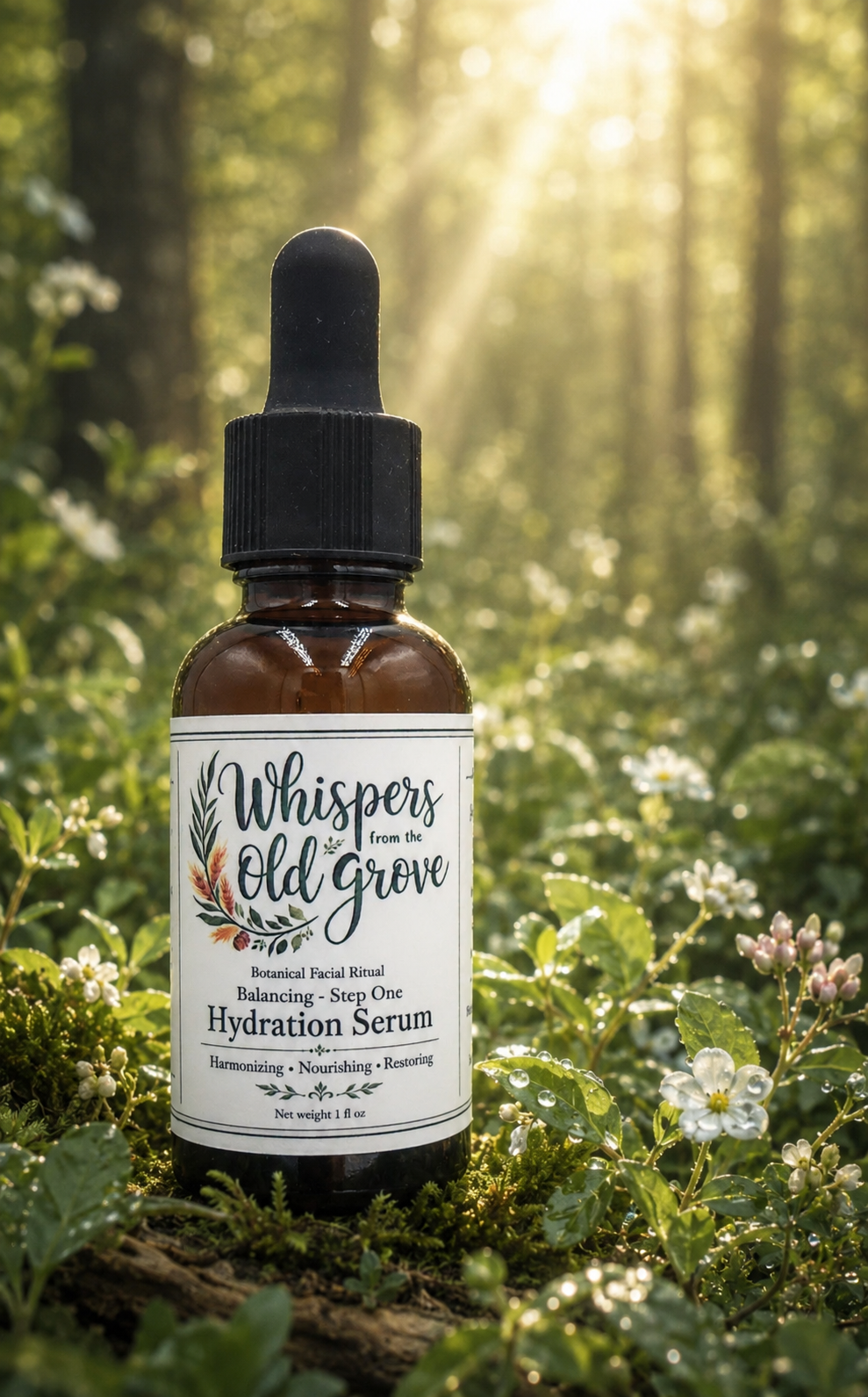
Facial Ritual - Hydration Serum
Facial Ritual - Hydration Serum
Couldn't load pickup availability
Deep hydration, calm restoration, and microbiome-balanced care in one lightweight, fast-absorbing serum.
WHY THIS FORMULA EXCELS
- Multi-layer hydration system: Glycerin + hyaluronic acid deliver both immediate and sustained moisture
- Barrier repair synergy: Panthenol + aloe actively support skin recovery and resilience
- Microbiome-conscious preservation: Radish ferment protects without disrupting skin balance
- Optimized delivery system: Water-based matrix enhances penetration and performance of actives
INGREDIENTS - KEY COMPONENTS - BENEFITS - SCIENTIFIC RATIONAL - REFERENCES
1. Aloe Vera Juice
INCI: Aloe Barbadensis Leaf Juice
Key Components:
- Polysaccharides (acemannan)
- Vitamins (A, C, E)
- Amino acids
- Phenolic compounds
Functional Role:
- Primary soothing base
- Bioactive hydration support
Skin Benefits:
- Calms irritation and reduces erythema
- Promotes wound healing and skin regeneration
- Provides light hydration and anti-inflammatory effects
Scientific Rationale:
Aloe polysaccharides stimulate fibroblast activity and collagen synthesis while modulating inflammatory pathways.
2. Aqua (Water)
INCI: Aqua
Key Components:
- Purified water (H₂O)
Functional Role:
- Solvent and delivery medium
Skin Benefits:
- Enhances penetration of hydrophilic actives
- Supports hydration when combined with humectants
Scientific Rationale:
Acts as the carrier phase, improving diffusion of active compounds into the stratum corneum.
3. Vegetable Glycerin
INCI: Glycerin
Key Components:
- Trihydric alcohol (glycerol)
Functional Role:
- Primary humectant
Skin Benefits:
- Draws moisture into the skin
- Improves barrier function
- Reduces dryness and scaling
Scientific Rationale:
Glycerin increases stratum corneum hydration and facilitates aquaporin-3 activity, enhancing water transport.
4. Hyaluronic Acid
INCI: Sodium Hyaluronate
Key Components:
- Glycosaminoglycan (glucuronic acid + N-acetylglucosamine)
Functional Role:
- Advanced humectant and moisture reservoir
Skin Benefits:
- Deep and surface hydration
- Improves elasticity and smoothness
- Reduces appearance of fine lines
Scientific Rationale:
Forms a viscoelastic film and binds significant water, supporting extracellular matrix hydration and skin integrity.
5. Panthenol (Provitamin B5)
INCI: Panthenol
Key Components:
- Alcohol analog of pantothenic acid
Functional Role:
- Barrier repair agent and conditioning humectant
Skin Benefits:
- Enhances skin barrier recovery
- Reduces irritation and redness
- Improves softness and elasticity
Scientific Rationale:
Converted to pantothenic acid in skin, supporting lipid synthesis and epithelial repair processes.
6. Leuconostoc/Radish Root Ferment Filtrate
INCI: Leuconostoc/Radish Root Ferment Filtrate
Key Components:
- Antimicrobial peptides
- Organic acids
- Fermentation-derived metabolites
Functional Role:
- Natural preservative system
- Microbiome-supportive postbiotic
Skin Benefits:
- Helps inhibit harmful microbial growth
- Supports balanced skin microbiota
- Provides mild conditioning and soothing effects
Scientific Rationale:
Fermentation-derived peptides exhibit antimicrobial activity while maintaining low irritation potential and supporting skin ecosystem balance.
REFERENCES
- Surjushe, A., Vasani, R., & Saple, D. G. (2008). Aloe vera: A short review. Indian Journal of Dermatology, 53(4), 163–166.
- Reynolds, T., & Dweck, A. C. (1999). Aloe vera leaf gel: A review update. Journal of Ethnopharmacology, 68(1–3), 3–37.
- Fluhr, J. W., et al. (2008). Glycerol and the skin: holistic approach to its origin and functions. British Journal of Dermatology, 159(1), 23–34.
- Pavicic, T., et al. (2011). Efficacy of topical hyaluronic acid in skin hydration and elasticity. Journal of Drugs in Dermatology, 10(9), 990–1000.
- Papakonstantinou, E., Roth, M., & Karakiulakis, G. (2012). Hyaluronic acid: A key molecule in skin aging. Dermato-Endocrinology, 4(3), 253–258.
- Ebner, F., Heller, A., Rippke, F., & Tausch, I. (2002). Topical use of dexpanthenol in skin disorders. American Journal of Clinical Dermatology, 3(6), 427–433.
- Proksch, E., et al. (2017). The skin: an indispensable barrier. Experimental Dermatology, 26(6), 551–557.
- Ziemlewska, A., et al. (2024). Antimicrobial properties of radish root ferment filtrate. International Journal of Cosmetic Science.
- Juliano, C., et al. (2024). Radish root ferment filtrate as a cosmetic preservative. Applied Sciences, 14(17), 7761.
- Rusic, D., et al. (2024). Cosmetic formulations with postbiotics and hyaluronic acid. PMC.
This information describes traditional use and published research and is not intended to diagnose, treat, cure, or prevent disease.
Talk about your brand
Share information about your brand with your customers. Describe a product, make announcements, or welcome customers to your store.