
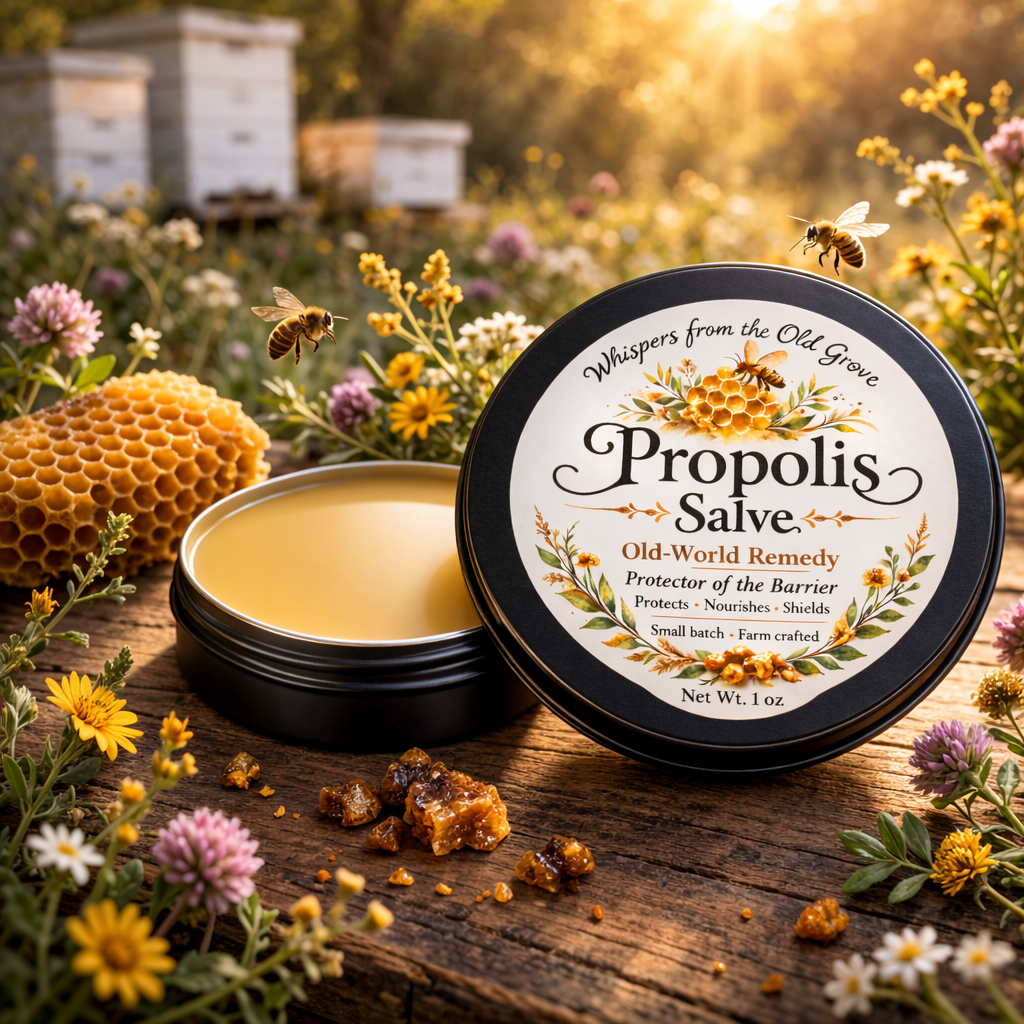
Propolis - Salve
Propolis - Salve
Couldn't load pickup availability
A deeply restorative botanical balm that heals, protects, and nourishes with the strength of the hive and the richness of nature.
WHY THIS FORMULA EXCELS
Repair + protection system: Propolis and beeswax support healing and barrier defense
Multi-layer lipid nourishment: Olive, almond, and marula deliver complementary fatty acids
Antioxidant network: Vitamin E, rosemary, and polyphenols protect against oxidative stress
Soothing + calming synergy: Lavender and propolis reduce irritation
Barrier sealing without heaviness: Beeswax locks in hydration while maintaining breathability
INGREDIENTS - KEY COMPONENTS - BENEFITS - SCIENTIFIC RATIONAL - REFERENCES
1. Olea Europaea (Virgin Olive Oil)
Common Name: Virgin Olive Oil
Key Components:
- Oleic acid
- Squalene
- Polyphenols (oleuropein, hydroxytyrosol)
Clinical Benefits:
- Improves skin hydration and softness
- Supports barrier repair and reduces TEWL
- Provides antioxidant protection against environmental stress
Scientific Rationale:
High oleic acid enhances lipid matrix fluidity, improving permeability and barrier replenishment, while polyphenols reduce oxidative damage.
2. Prunus Amygdalus Dulcis (Sweet Almond Oil)
Common Name: Almond Oil
Key Components:
- Oleic and linoleic acids
- Phytosterols
- Tocopherols
Clinical Benefits:
- Improves skin tone and smoothness
- Reduces irritation and dryness
- Enhances barrier function
Scientific Rationale:
Fatty acid composition supports epidermal lipid balance and improves stratum corneum integrity.
3. Propolis Extract
Common Name: Propolis
Key Components:
- Flavonoids (pinocembrin, galangin)
- Phenolic acids
- Terpenes
Clinical Benefits:
- Promotes wound healing and skin repair
- Provides antimicrobial protection
- Reduces inflammation and irritation
Scientific Rationale:
Flavonoids and phenolics exhibit antimicrobial and anti-inflammatory activity, supporting tissue regeneration and microbial balance.
4. Cera Alba (Beeswax)
Common Name: Beeswax
Key Components:
- Esters
- Fatty acids
- Long-chain alcohols
Clinical Benefits:
- Forms a protective barrier to prevent moisture loss
- Supports skin repair
- Provides mild antimicrobial protection
Scientific Rationale:
Creates a semi-occlusive film that reduces TEWL while maintaining breathability and flexibility.
5. Tocopherol (Vitamin E)
Common Name: Vitamin E
Key Components:
- α-tocopherol
Clinical Benefits:
- Protects against oxidative stress and UV damage
- Supports skin healing
- Improves barrier stability
Scientific Rationale:
Acts as a lipid-phase antioxidant, preventing lipid peroxidation and stabilizing cellular membranes.
6. Lavandula Angustifolia (Lavender) Oil
Common Name: Lavender
Key Components:
- Linalool
- Linalyl acetate
Clinical Benefits:
- Promotes wound healing
- Reduces redness and irritation
- Provides mild antimicrobial effects
Scientific Rationale:
Modulates inflammatory pathways and supports tissue regeneration while offering antimicrobial activity.
7. Sclerocarya Birrea (Marula) Oil
Common Name: Marula Oil
Key Components:
- Oleic acid
- Linoleic acid
- Antioxidants (tocopherols, flavonoids)
Clinical Benefits:
- Enhances hydration and elasticity
- Improves skin smoothness
- Provides antioxidant protection
Scientific Rationale:
High oleic content improves absorption and barrier repair, while antioxidants protect against environmental stressors.
8. Rosmarinus Officinalis (Rosemary) Leaf Extract/Oil
Common Name: Rosemary
Key Components:
- Rosmarinic acid
- Carnosic acid
- Carnosol
Clinical Benefits:
- Provides strong antioxidant protection
- Supports skin vitality and circulation
- Helps stabilize formulation
Scientific Rationale:
Phenolic diterpenes act as potent free radical scavengers, protecting both skin and formulation from oxidative degradation.
REFERENCES
- Lin, T. K., Zhong, L., & Santiago, J. L. (2018). Plant oils and skin barrier repair. International Journal of Molecular Sciences, 19(1), 70.
- Viola, P., & Viola, M. (2009). Virgin olive oil as a skin protectant. Clinics in Dermatology, 27(2), 159–165.
- Ahmad, Z. (2010). The uses and properties of almond oil. Complementary Therapies in Clinical Practice, 16(1), 10–12.
- Bankova, V. (2005). Propolis: recent developments and biological properties. Evidence-Based Complementary and Alternative Medicine, 2(1), 29–32.
- Fratini, F., et al. (2016). Beeswax antimicrobial activity. Asian Pacific Journal of Tropical Medicine, 9(9), 839–843.
- Thiele, J. J., et al. (2005). Vitamin E in dermatology. Dermatologic Surgery, 31(7), 805–813.
- Cavanagh, H. M. A., & Wilkinson, J. M. (2002). Biological activities of lavender essential oil. Phytotherapy Research, 16(4), 301–308.
- Komane, B., et al. (2017). Marula oil composition and dermatological benefits. Journal of Ethnopharmacology.
- Nieto, G., et al. (2018). Rosemary as a natural antioxidant. International Journal of Food Science & Technology, 53(2), 309–316.
This information describes traditional use and published research and is not intended to diagnose, treat, cure, or prevent disease.
Talk about your brand
Share information about your brand with your customers. Describe a product, make announcements, or welcome customers to your store.